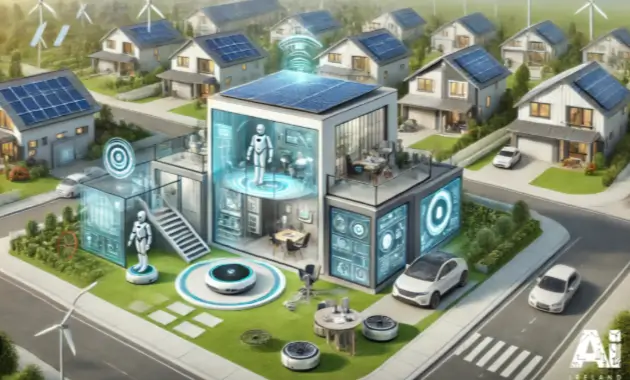

The future of AI-powered homes envisions seamless, anticipatory living guided by privacy-conscious automation and robust governance. Data-minimized flows, verifiable safeguards, and interoperable ecosystems shape energy, maintenance, and comfort with measurable efficiency. Personalization respects user autonomy while embedding safeguards and sustainability metrics. As habitats become more adaptive, trusted autonomous systems will scale intelligently yet remain accountable. The question remains: how will transparent governance and ethical sourcing translate into everyday resilience and trust?
How AI Shapes Day-To-Day Living
AI-enabled systems increasingly weave into daily routines, converting routine tasks into smooth, anticipatory experiences. The analysis highlights privacy lag as a measurable friction, while data minimization guides sensor selection and processing. Automation resilience anchors uninterrupted living, yet ethical sourcing reinforces trust. Forward-looking design favors user autonomy, transparent reporting, and scalable interoperability, enabling freedom through purposeful, data-driven improvements that align with personal values and long-term well-being.
Privacy, Security, and Trust in Smart Homes
Privacy, security, and trust form the backbone of smart homes, where data flows are mapped, monitored, and regulated to protect occupants while enabling intelligent orchestration.
The vision emphasizes resilience, transparent governance, and verifiable safeguards, reducing privacy concerns through principled architectures and automated controls.
Data minimization emerges as a core discipline, empowering freedom while ensuring privacy, security, and trusted, autonomous home ecosystems.
See also: How Hybrid Cloud Solutions Support Modern Organizations
Choosing, Using, and Troubleshooting AI Home Systems
As smart homes progress from principle to practice, selecting and operating AI-driven systems becomes a matter of aligning capabilities with measurable outcomes: energy efficiency, predictive maintenance, and seamless orchestration across devices.
The piece emphasizes choosing protocols, using voice assistants, privacy concerns, and security best practices, guiding users toward freedom with transparent configurations, robust updates, and data-driven decision-making for resilient, user-centric automation.
The Path Forward: Personalization, Sustainability, and Regulation
What lies ahead for AI-powered homes hinges on three coordinated pillars: personalization, sustainability, and regulation. The path forward emphasizes adaptive systems guided by personalization ethics, balancing user autonomy with safeguards. Sustainability metrics will quantify efficiency gains, emissions, and lifecycle impacts. Regulators will align innovation with trust, ensuring interoperability, data integrity, and transparent accountability while maintaining freedom to explore transformative design, privacy, and choice.
Frequently Asked Questions
What Happens if AI Systems Malfunction During Emergencies?
In emergencies, AI failure mitigation activates layered redundancy and autonomous indicators, enabling safe handoff to human oversight. Emergency protocol design prioritizes resilience, transparent diagnostics, and rapid restoration, empowering residents to maintain freedom while systems recalibrate without compromising safety or autonomy.
How Do AI Homes Handle Power Outages and Offline Operation?
AI homes maintain critical functions through offline operation and power redundancy, ensuring essential control remains when grids fail; systems switch to autonomous modes, verify integrity, and optimize energy use, presenting a data-driven, visionary path toward resilient freedom.
Can AI Homes Imitate Human Emotions in Interactions?
AI homes can imitate human emotions in interactions, yet exhibit synthetic behavior governed by imitation ethics and programmed constraints, ensuring emotional transparency while balancing user autonomy with utility, signaling a future where data-driven empathy reinforces freedom rather than replacing it.
What Are Long-Term Environmental Impacts of AI Hardware?
Long term environmental impacts arise from AI hardware manufacturing, as energy intensity, material extraction, and e-waste accumulate; yet visionary data-driven strategies enable circularity, cleaner supply chains, and adaptive design, empowering freedom while forecasting sustainable, resilient AI-enabled futures.
How Will AI Homes Influence Energy Market Dynamics?
AI homes will reshape energy markets through AI driven load shifting and enhanced demand flexibility; this catalyzes Renewable integration dynamics, enabling faster, smarter decarbonization, while empowering consumers to participate freely in resilient, market-driven energy systems.
Conclusion
In the quiet glow of dawn, smart homes awaken like orchards of obedient satellites, each device a careful custodian of data. Silhouettes of energy use bend toward efficiency, dashboards pulse with transparent metrics, and governance threads weave a secure, privacy-respecting lattice. As systems learn, neighborhoods grow more resilient, harmonizing comfort with autonomy. The path ahead promises scalable, trustworthy ecosystems where innovation flourishes, yet every byte travels with purpose, accountability, and the patient certainty that homes protect what matters most.